Eighteen reasons to stop construction of Sizewell C nuclear power plant on the Suffolk coast and focus on renewable energy and storage:
1/ Sizewell C will take many years to build and complete even though other renewable energy technologies come on line much more quickly.
Sizewell joint managing director Julia Pike told the BBC that Sizewell C Is not expected to come on line until the early 2030s.
https://www.bbc.co.uk/news/articles/cev03wer0p2o
On the other hand, new onshore wind and solar farms take a few months to construct and offshore wind farms can be ready in18 months according to Danish wind turbine giant Vestas
While Sizewell C is scheduled eventually to have the capacity to produce 3.2 gw of electricity, the UK government has already approved plans for multiple times that capacity in renewable energy. Its latest licensing round (January 2026) is for 8.4 gw of power. https://davidtoke.substack.com/p/biggest-ever-uk-offshore-windfarms?fbclid=IwY2xjawPXPE1leHRuA2FlbQIxMQBzcnRjBmFwcF9pZA80MDk5NjI2MjMwODU2MDkAAR4NiPsok8kVM0XUSXPI6STqFHx6X3woLj0CMyGjSeLMynhg3RWJoRpDQsomfg_aem_IoQvbd7j1oLFDTkGqFdJ_w
2/ Sizewell C will cost many billions of pounds to build and the final cost will not be known for many years.
The latest official cost estimate is £38 bn and the government will hold a 44.9% stake in the power station, implying that the government expects to hand over at least around £14 bn of taxoayers’ money.
The final total could reach £100 bn once cost increases and interest payments on funding are included, according to modelling by the Financial Times.
https://www.ft.com/content/5f54592e-50ba-4a1e-8219-7a4eb01f74ed
3/ Sizewell C can only be built with huge government subsidy as insufficient private investors are willing to invest.
4/ Sizewell C would be at severe risk of erosion, well within its proposed 50 year operating life.https://www.scribd.com/document/84289220/Nuclear-sites
5/ Need for vast clean water supplies, which have yet to be found for Sizewell C, causing EDF to propose a desalination plant, which they say will be ‘temporary’
https://www.theguardian.com/commentisfree/2022/jul/27/nuclear-power-station-sizewell-c-water-suffolk
https://www.bbc.co.uk/news/articles/cy54kee1py3o
6/ Harmful impact, possibly terminal, on nationally important nearby wildlife sites, especially the RSPB’s adjoining Minsmere nature reserve, at a time when diversity of nature in the UK including Suffolk has already been severely damaged and sharply reduced by human activity. https://www.rspb.org.uk/helping-nature/what-we-do/influence-government-and-business/casework/sizewell-c-nuclear-power-station-case-study
7/ The project does nothing for energy security, as construction and operation will be under foreign control. Sizewell C’s will be built by and equipment supplied by French state-owned Electricite de France, who could at any moment prioritise projects outside Britain or stop construction.
EDF’s finances are very weak and the French government has agreed to inject €9.7 bln into the company to fully nationalise it.
UK governments have recognised that foreign control of huge nuclear plants is not a good idea and have granted multi-million pound subsidies to Rolls-Royce to develop what they call SMR (small and medium) reactors.
8/ Where will the uranium come from? Neither Britain nor France have any exploitable uranium deposits I have asked this question to everyone I have ever talked to with links to the UK nuclear industry and noone has ever suggested a source.
A large proportion of global uranium deposits are in unsavoury countries, eg Kazakhstan. For several decades EDF and it’s predecessors have sourced uranium from Niger, one of the world’s poorest countries. Niger is currently joint 188th of 193 states on Fridaythe UN’s Human Development Index.
9/ The EPR pressurised water reactor proposed by EDF for Sizewell C has a history of long delays and cost overruns. Only a few have been built anywhere in the world.
The Olkiluoto 3 EPR reactor in Finland started commercial operation only in May 2023, 14 years later than initially intended. Construction began in 2005. This means Sizewell C would be unlikely to contribute towards battling climate breakdown within the next 20 years, at a time when immediate action is needed.
The Hinkley 3 EPR reactor in Somerset is 10 years behind schedule with no sign of operations starting any time soon.
9/ There is an unquantifiable risk of a devastating deadly accident, such as happened at nuclear power plants in Chernobyl in Ukraine and Fukushima in Japan.
10/ Target for terrorism or hostile attack by a foreign power. This is no idle threat after Russia’s invasion of Ukraine led to fears of an assault on a major nuclear plant there.
11/ Inability to adjust to variations in electricity demand. Like renewables requires storage to match supply and demand
13/ Threat to sealife from sucking in water for use in the plant and then the outfall of warm waters.
14/ Need for safe storage of spent uranium for thousands of years – yet to be found for most existing nuclear plants
15/ Huge decommissioning costs, which usually have to be funded by the taxpayer
16/ Vulnerability to heatwaves, which are likely to be a greater problem over time, causing the plant to have to shut down. This is happening increasingly frequently in France, which as relied heavily on nuclear power for several decades but is now ramping up wind and solar power as fast as it can,
17/ Inflexible nuclear power sometimes has a negative effect on renewable energy plants, causing them sometimes to be unable to feed power into the grid at times of excess production.
18. Destruction of major archaeological sites showing evidence of human occupation going back thousands of years.https://www.sizewellc.com/news-views/nationally-significant-anglo-saxon-burial-ground-found-at-sizewell-c-site/
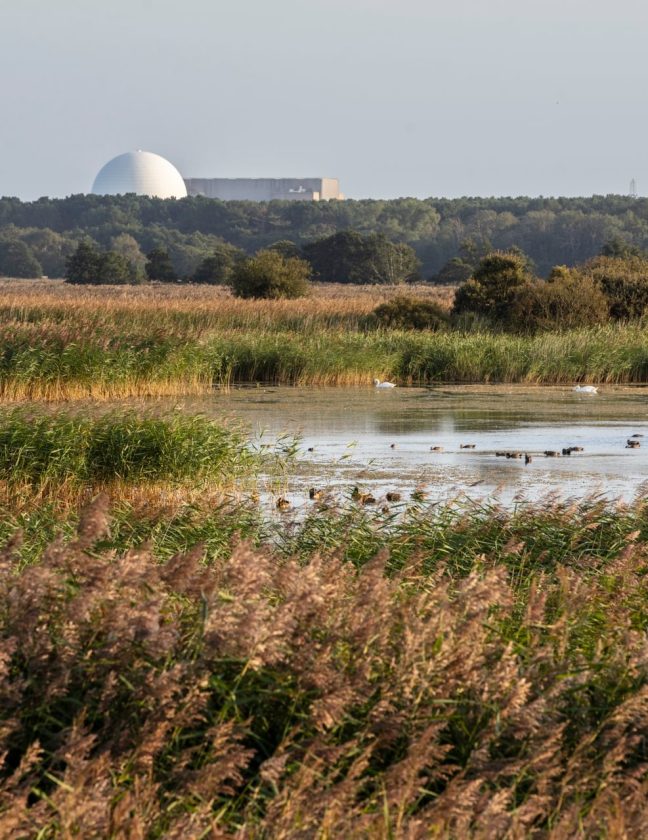
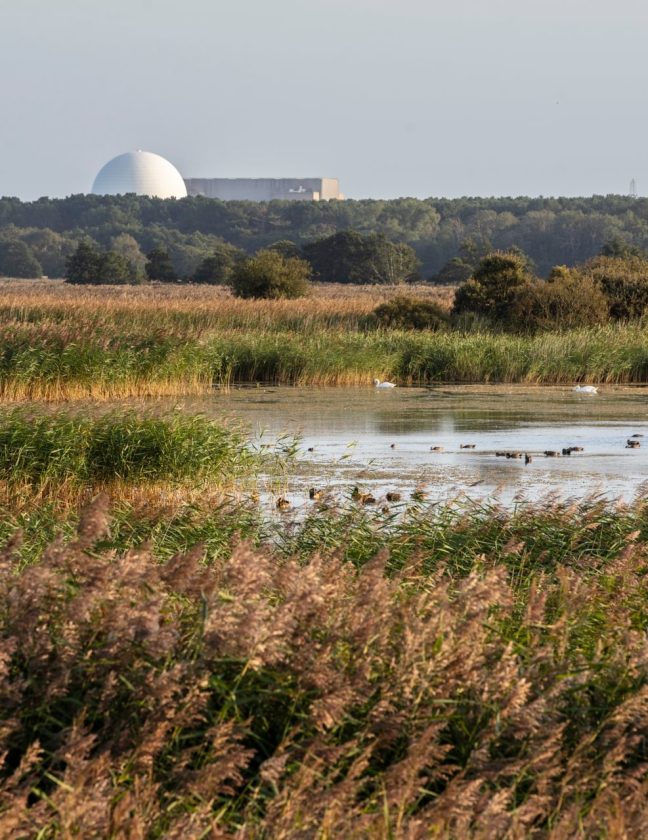
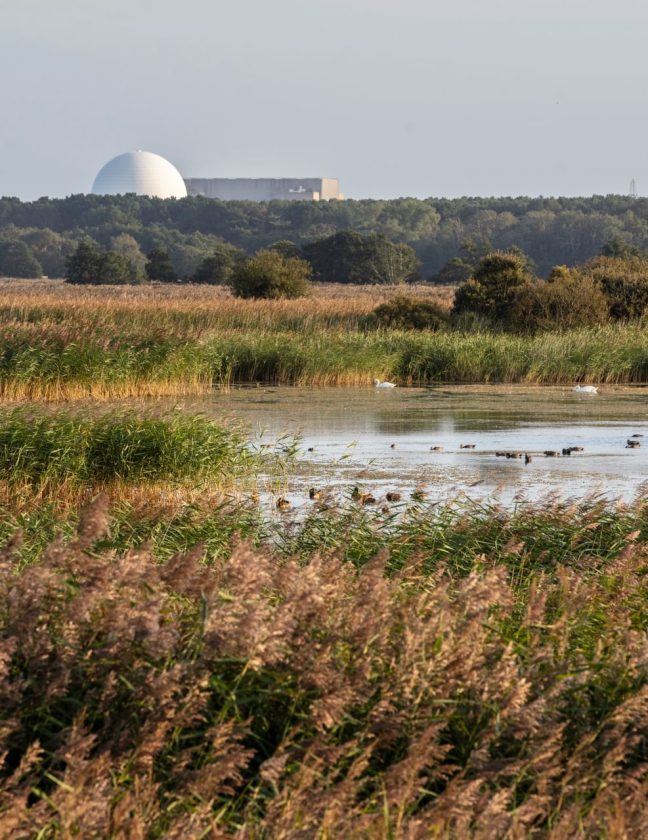
View of the Sizewell nuclear plant from Minsmere nature reserve
 Waveney wonderings